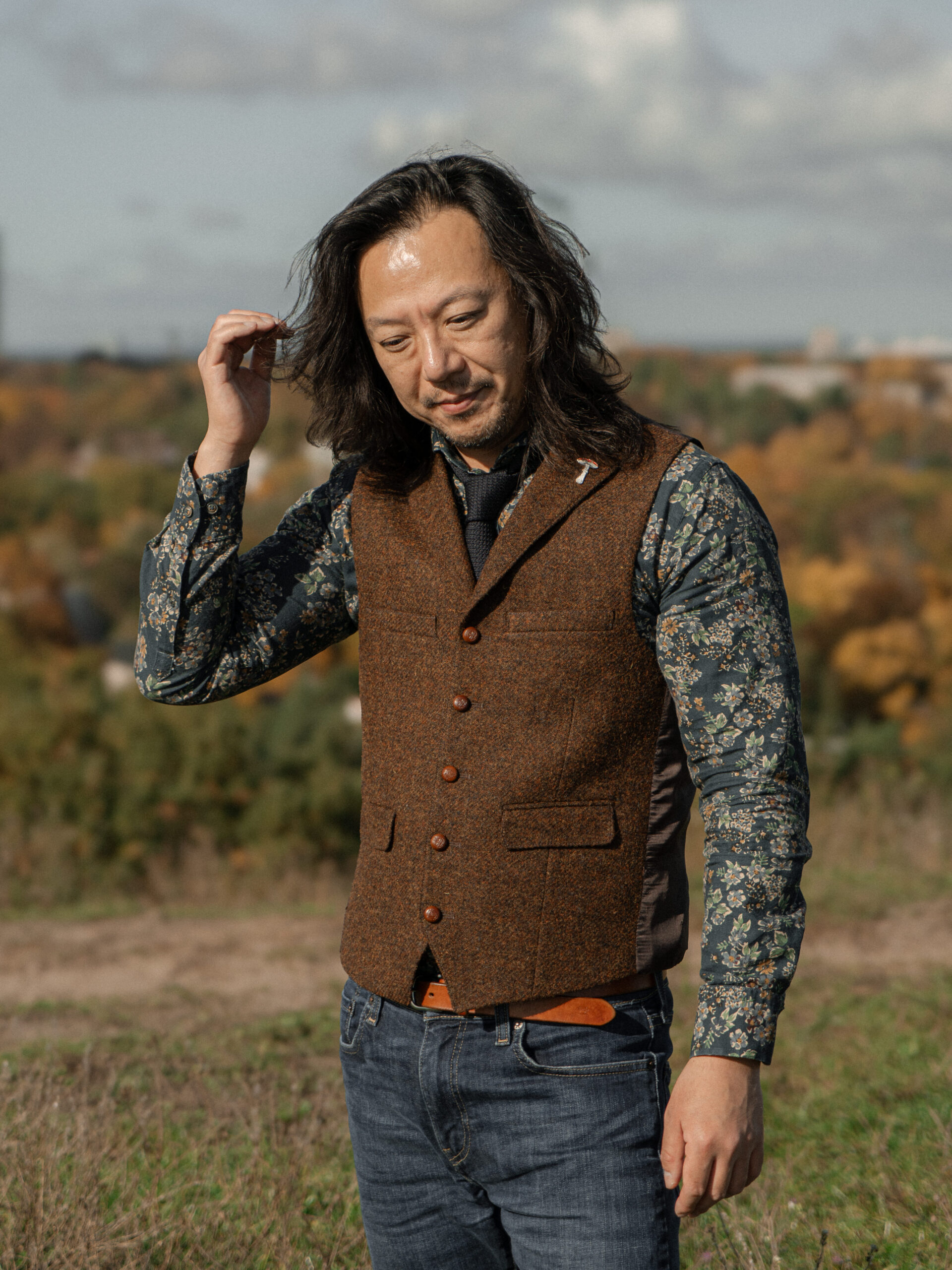
Tetsuya Hori creates contemporary, post-classical, electronic, and ambient music where instruments, voices, objects, movement, and silence become part of one living space — and his two latest albums, Voltaic Landscape: New Horizons and Winterreise Echoes, open two distinct worlds of memory, distance, texture, and imagination.
The Interview
Introduction
Q: For people discovering you for the first time: how would you describe yourself as a composer today — and what kind of space do you hope your music opens for listeners, performers, or audiences?
Tetsuya: This may sound like a strange thing to say in the very first answer, but I’d be happy if people thought of me as a somewhat baffling, all-over-the-place artist. I write neoclassical, contemporary classical, experimental, and ambient music. I sometimes venture into pop, I sometimes make music that can feel slightly absurd or leave people wondering what on earth is happening, and I’ve even ended up dancing onstage alongside dancers.
What connects all of that is my desire to offer listeners something they haven’t encountered before. It might be a piece of otherworldly nonsense, or music that is beautiful yet somehow uncanny and strange. I want to pick up things that listeners or other musicians might have overlooked and find new value in them.
Q: Your journey begins in Sapporo/Hokkaido, with organ at the age of four, early composition, studies in Japan, and later a move to Berlin. Looking back, what moments most shaped the way you listen and compose?
Tetsuya: I moved through classical music, jazz, pop, funk, contemporary classical music, and experimental music, roughly in that order. Each of them changed the way I listen, but I always felt a little out of place in every scene.
Strangely enough, the moment that most shaped the way I compose came quite recently. I realized that if I felt out of place in all those worlds, I didn’t need to find the one where I belonged. I could simply make the music I wanted to make at that particular moment. I no longer needed to decide what I was supposed to be.
Latest Work
Q: Please introduce your two latest albums, Voltaic Landscape: New Horizons and Winterreise Echoes, in your own words. What do these two works represent for you right now, and how would you like listeners to enter their worlds?
Tetsuya: These two works are probably good examples of what I was just talking about. In Winterreise Echoes, I brought ideas from contemporary classical and experimental music into a neoclassical setting. In Voltaic Landscape: New Horizons, you can still hear my classical background, but the album freely moves between different genres and musical worlds.
Winterreise Echoes was inspired by Schubert’s song cycle Winterreise. I took its emotional world as a starting point, then followed it in a different direction.
For Voltaic Landscape: New Horizons, I imagined people leaving Earth, landing on another planet, and beginning to settle there. I pictured the process of settling on that planet as one large painting and composed music for its different scenes. 1605munro primarily contributed the noise-based sound design. I wanted to feel free to try anything, so the album shifts quite wildly from one musical world to another.
I hope listeners bring their own images to both works. The specific images I had in mind were simply there to make the composing process clearer and smoother for me.
Q: Voltaic Landscape: New Horizons opens a cinematic, almost otherworldly terrain — part landscape, part memory, part future. What drew you to this world, and how did you shape its sense of movement, distance, and discovery through sound?
Tetsuya: I was drawn to the idea of landing somewhere completely unknown while still carrying memories of Earth. I imagined unfamiliar dawns, hallucinogenic jungles, mirages, vast silent plains, an endless ocean, and the creatures beneath it, as well as the settlers gradually accepting a new everyday life. All of these scenes formed one large painting in my mind, and I turned them into pieces of music one by one.
The motif at the beginning of the album is an homage to Dvořák’s Symphony No. 9, From the New World. It felt perfect for the album’s concept. The motif recurs in other pieces, each time in a different form.
I also made some deliberately sharp changes in the music. For example, the first half of the album has several pieces with a clear rhythm, while in the second half, I placed pieces in which almost nothing moves. I wanted those changes to give each place its own sense of scale and atmosphere.
Q: Winterreise Echoes carries a different atmosphere: quiet, winterlike, spacious, and reflective. What relationship does this album have to Schubert’s Winterreise, and what did you want to express through your own echo of that emotional landscape?
Tetsuya: I find the world of Schubert’s Winterreise relentlessly dark and full of despair. Whenever I listened to it, I found myself talking back to the songs one by one: “Come on, it doesn’t have to be quite that hopeless. Couldn’t things go another way?” That’s what led me to make Winterreise Echoes.
I wasn’t trying to erase the darkness of the original work. I wanted to see what might happen if, somewhere within that winter landscape, there was still a little room for warmth or hope. And just to be clear, I love the song cycle Winterreise and have enormous respect for Schubert!
Creative Approach
Q: Your music often brings together acoustic instruments, electronics, voices, objects, and unusual sound sources such as beer bottles or cassette tapes. How do you know when a sound source belongs in a piece?
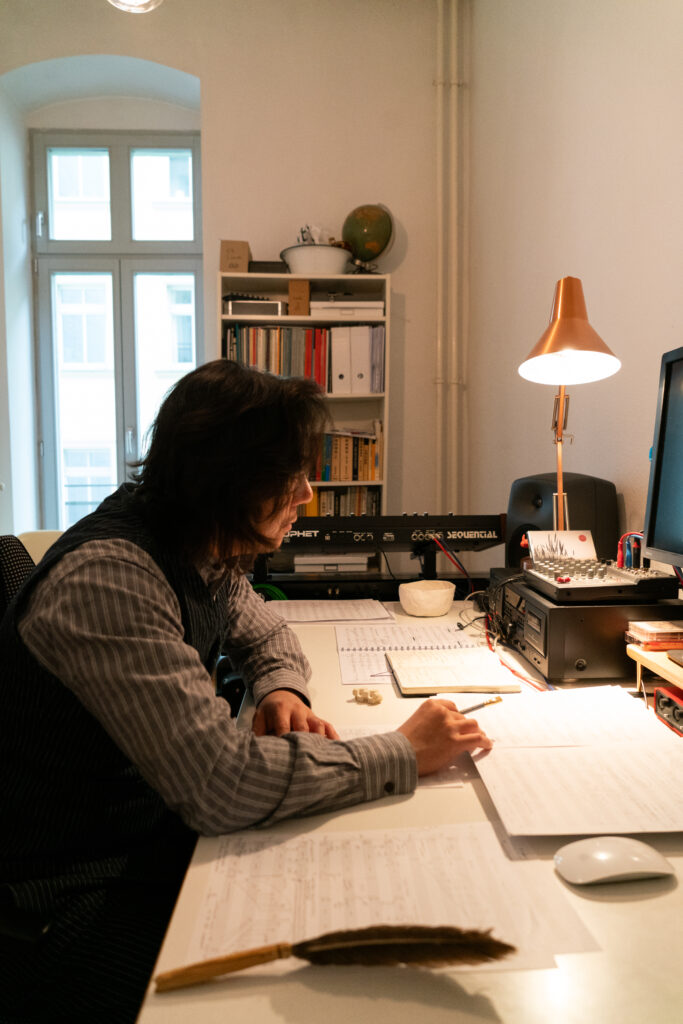
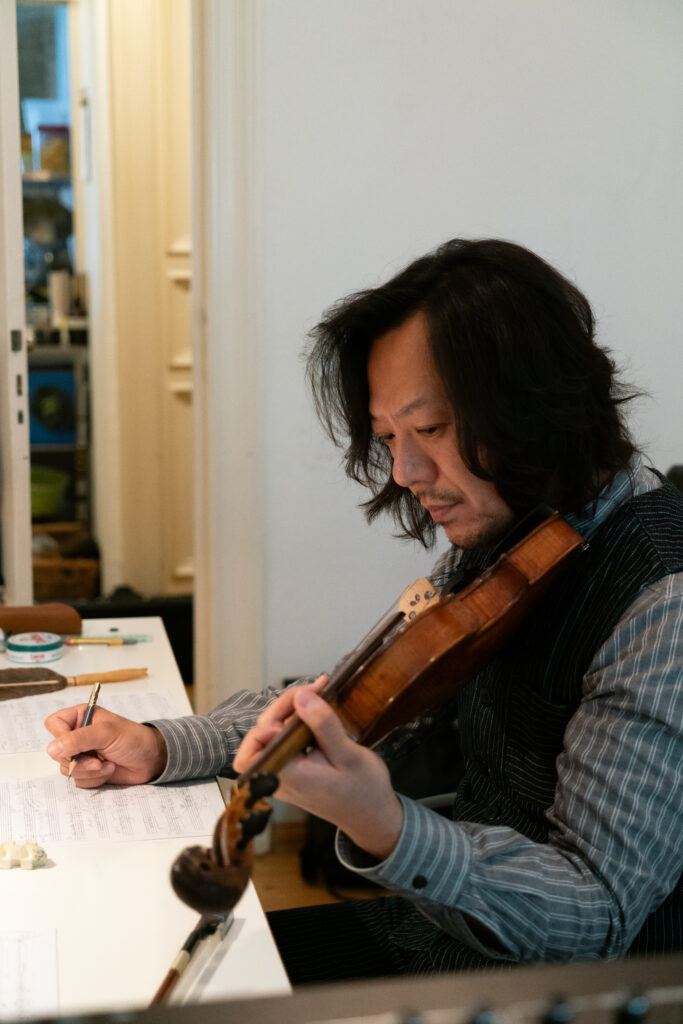
Tetsuya: I always decide on the instrumentation before I start composing. Objects are candidates for instruments at that stage, too. The texture of the sound matters, of course, but I also imagine the piece being performed in front of an audience. How exciting would it be to watch someone make that sound? How interesting is the movement required to produce it?
I’m also drawn to the contrast between what the audience sees and what they hear. An object or a way of playing it can look almost comical and still produce a beautiful sound. I enjoy that little bit of nonsense.
Q: In your dance and stage-related work, music is described not as accompaniment, but as a partner to movement, dramaturgy, body, and space. How does this stage perspective influence your concert works and recorded releases?
Tetsuya: Working on dance and other stage productions has made me pay much more attention to the performer’s movements when I compose. I imagine what a musician will physically do to produce a sound, and the visual effect has become part of how I think about the piece.
That matters especially in my concert works. In a recording, of course, listeners can’t see any of it, and that’s where it gets tricky for me. In some of my pieces, the music only makes full sense when you can see the musician’s movements. There are several pieces I haven’t been able to release for that reason.
Q: Can you describe a moment during the creation of one of these works where everything clicked — or where a piece almost fell apart?
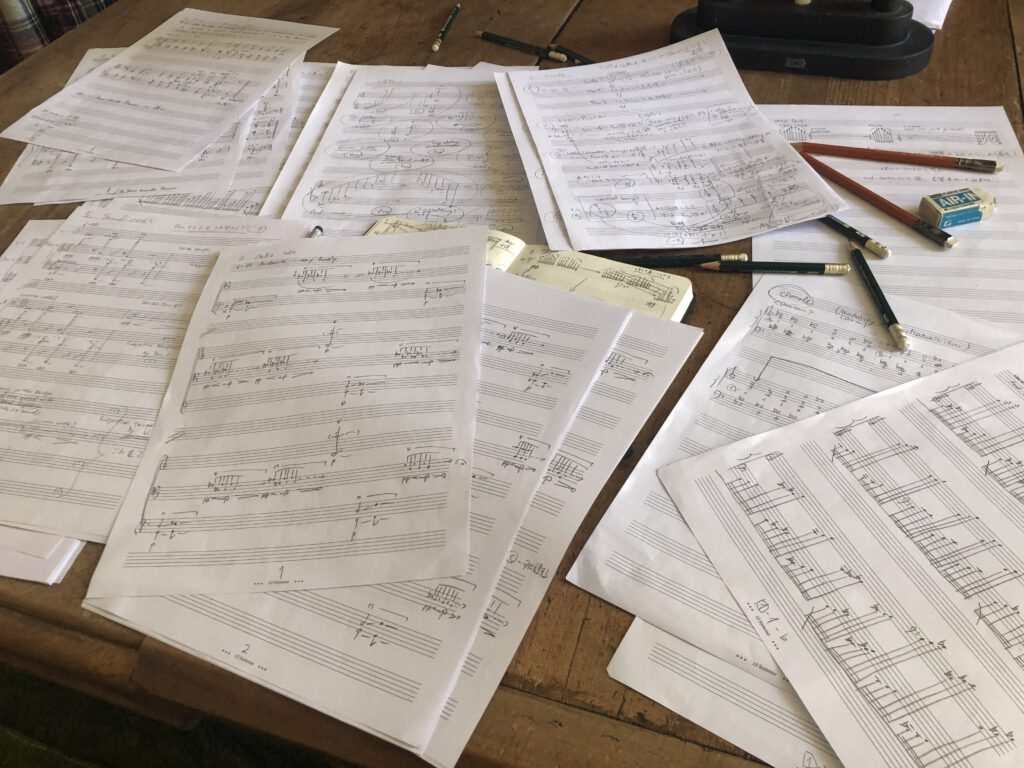
Tetsuya: This kind of problem comes up all the time when I compose. I solve one thing, and another stops working. If I try to force everything to work at once, the whole piece can fall apart.
A recent example is Vast Silence from Voltaic Landscape: New Horizons. I wanted to capture a vast landscape I had experienced on a road trip through Iceland, where I saw no sign of life anywhere. It was beautiful, yet somehow uncanny and strange. When I reduced the instruments and sounds to a minimum, the piece no longer seemed to fit with the surrounding tracks, which use synthesizers much more heavily. But adding synthesizers to Vast Silence destroyed the unsettling quiet at its heart.
After thinking about it for a long time, I decided to have the strings play without vibrato. Their sound became almost like a sine wave, so they sat naturally beside the synthesizers on the surrounding tracks. At the same time, when heard on their own, the strings reminded me slightly of Nordic folk music. One small decision ended up solving both problems at once.
Personal & Creativity
Q: When you are not composing, what tends to refuel your creativity most — daily life, cities, silence, nature, objects, theatre, movement, conversations, or something else?
Tetsuya: When I’m not composing, I try to step away from sound as much as possible. I like turning what I see into sound, so I enjoy wandering through museums and galleries. Unlike music, a painting, or an object, it lets me experience it at my own pace. I can pause, look more closely, and move on when I’m ready.
Q: How do you deal with doubt, creative blocks, or periods when the sound world of a piece is not yet clear?
Tetsuya: When I get stuck, I keep thinking about the piece, even when I feel like it might not be helping. I think and think, and eventually I go for a walk. I believe the more time I spend with a problem, the more likely I am to find a way through it — even if, in the end, that means giving up.
Inspiration & Listening
Q: Which composers, artists, performances, places, or non-musical influences have inspired you most recently — and what exactly did they open up for you?
Tetsuya: I recently recorded a neoclassical piece for solo double bass. Jaco Pastorius’s Portrait of Tracy inspired me to explore what a single bass instrument could do. In my own piece, I wanted to create music that was beautiful, yet somehow uncanny and strange.
I’ve also recently tried composing by facing the emotions I’m carrying right now head-on. I won’t say exactly what they are because they’re very personal, but the result is shaping up to be a very beautiful album.
Creative Philosophy & Vision
Q: Experimentation seems central to your work, but your music also carries emotional clarity. How do you balance risk, structure, intuition, and feeling?
Tetsuya: Before I start composing, I make the concept clear and form a painting of its story in my mind. The emotions are already part of that painting. At the same time, I decide on the instrumentation. Then, as I compose, I keep moving between looking closely at the details of the painting and stepping back to see the whole image.
Q: If there were no limits — no budget, no deadlines, no technical restrictions — what kind of dream project would you like to create?
Tetsuya: Having no limits at all would actually make it difficult for me to create anything. I forgot to mention this in my previous answer, but when I picture that painting, I start by deciding on its frame. Without a frame, you can’t make the painting, and without one, I can’t compose either.
That said, if I had a generous budget, I would love to create a large-scale stage production, perhaps something like an opera. It might begin with neoclassical music, but knowing myself, I doubt it would stay within one genre for long. It would be quite different from a conventional opera, and that would make it exciting for me.
From Silence to Sound – Creative Identity
Q: I often explore how personal decisions shape a musician’s signature sound. Which choices define yours most clearly — your instrumentation, your sense of space, your use of electronics, your relationship to silence, or the way you connect sound with movement?
Tetsuya: I think what defines my work is the urge to propose possibilities that might seem strange at first. Why not play an instrument this way? Why not put these genres together? Why not use an everyday object as an instrument? I want to offer new ways of valuing sounds, movements, and combinations that might otherwise be overlooked. “Interesting nonsense” might be the best description of what I’m after.
Closing
Q: What do you hope listeners, performers, or audiences feel when they spend time with your music?
Tetsuya: I’ve talked a lot in this interview about the images and ideas I had in mind as the composer, but I hope listeners imagine their own stories and scenes when they hear my music. I’d love for them to imagine things I never would have thought of myself.
Q: What advice would you give to someone at the beginning of a creative journey who wants to build a personal language but feels overwhelmed by tools, styles, or expectations?
Tetsuya: I wouldn’t try to define your personal language before you start making things. Make what you want to make now, even if it doesn’t fit neatly into a style or meet someone else’s expectations. You may only recognize your own language after you’ve made a few pieces. That’s about all I can offer.
Q: Finally, what is next for you — compositionally, collaboratively, and creatively? What should we be looking forward to in the coming months?
Tetsuya: I have several pieces in progress at different stages. Some have already been recorded and edited, some are well underway, and others I’m still composing. I expect to share them gradually throughout 2027.
In October 2026, I’ll be part of a new dance production, The Beach Day Variance. I composed the music, but I’m also one of the musicians onstage, playing piano and sometimes dancing with the dancers. My role in the piece is to connect the music and the dance.