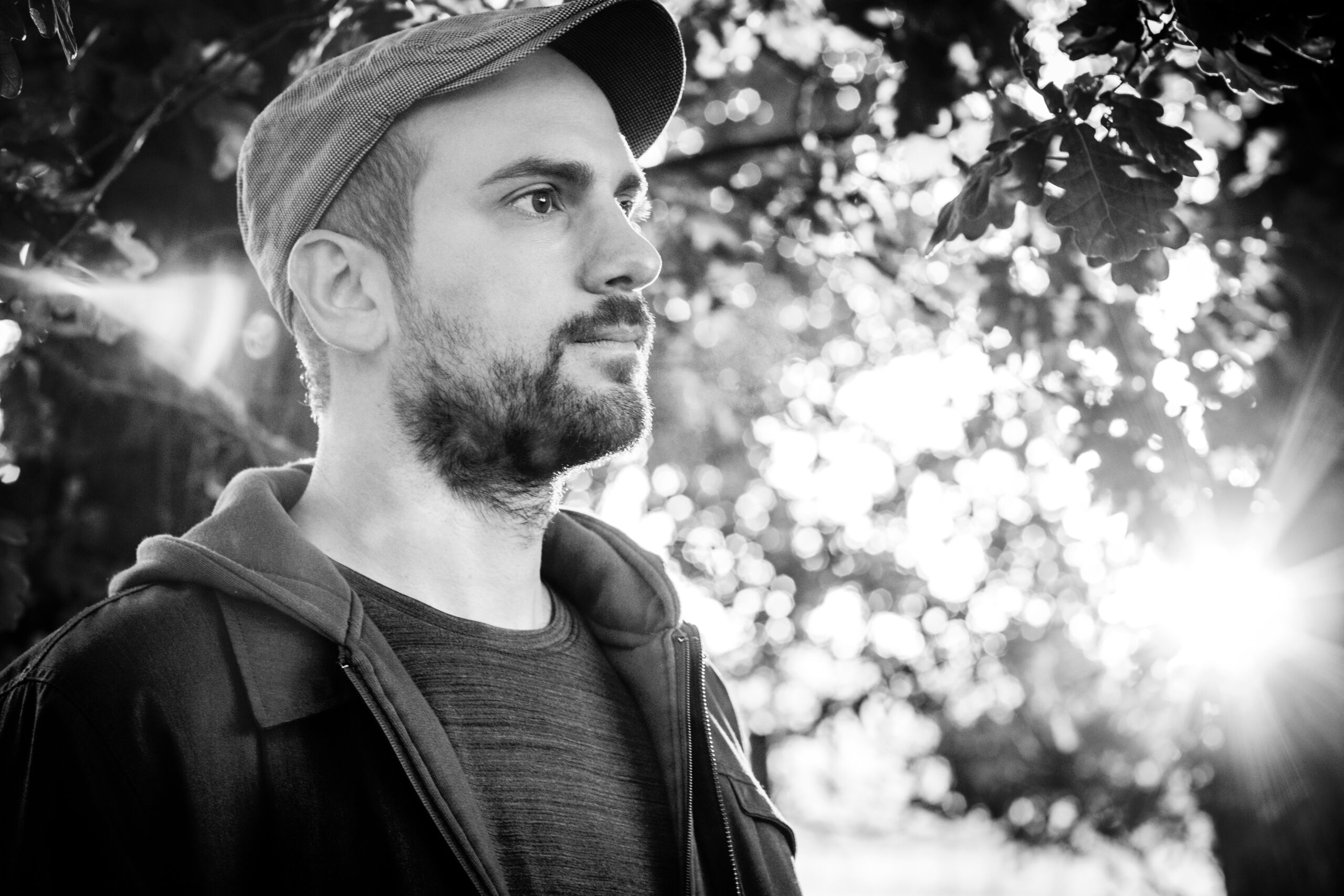
Andreas Bach is a versatile guitarist, producer, and guitar teacher from Osnabrück, Germany, known for warm tones and calming melodies shaped by years on stage and in the studio. Rooted in guitar-driven rock yet inspired by atmospheric worlds in the spirit of Sigur Rós, Esbjörn Svensson, and Pink Floyd, he blends crafted guitar sound with subtle electronics into intimate, cinematic ambient/downtempo pieces. He’s also the author of Beginner’s Guitar (SCHOTT Music), bringing the same clarity and musical sensitivity to his teaching and writing.
The Interview
Introduction
Q: For those who don’t know you yet: how would you describe yourself as an artist today—especially the role of the guitar as your “voice”?
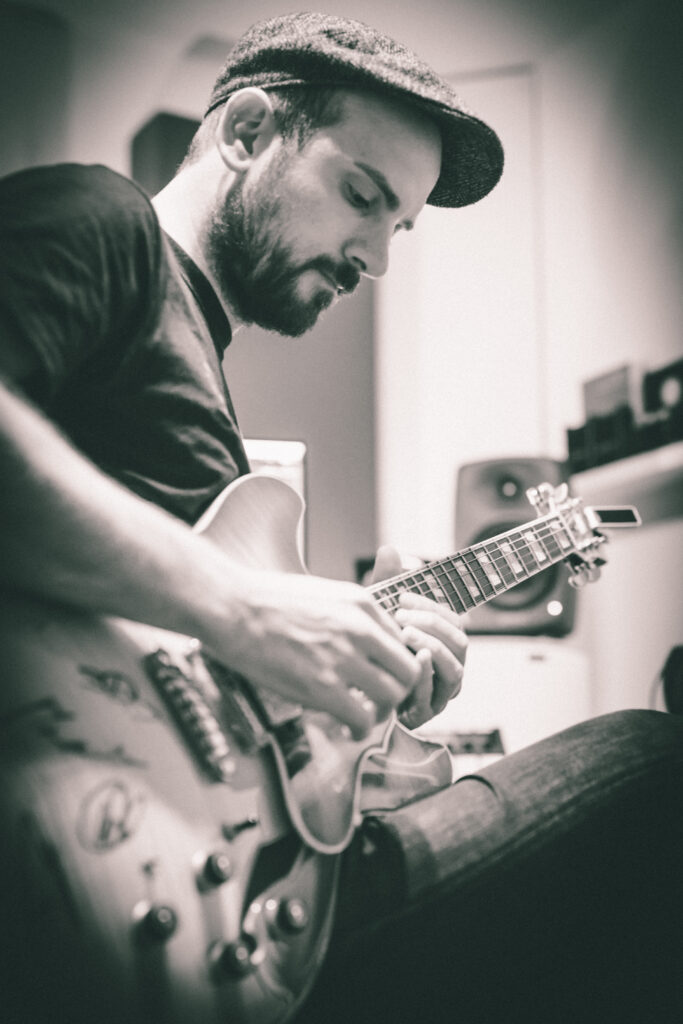
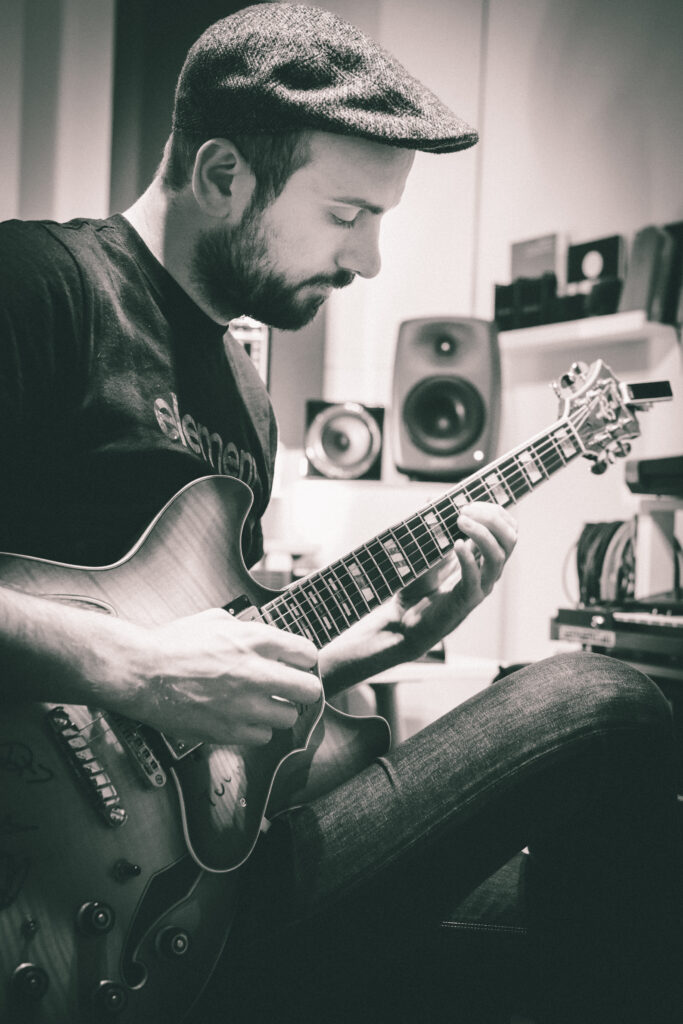
Andreas: It’s always difficult to talk about yourself. A brief summary would be: I’m a musician, and my main instrument is the guitar—I’ve been playing it for 30 years. It’s naturally my primary voice, but I also like to try anything I can get my hands on. I love many different genres and tend to take something I enjoy from each of them and weave it into my own music.
Q: You’re active in very different worlds: ambient/downtempo production on one side, and high-energy live bands on the other. What does each world give you—and what do you take from one into the other?
Andreas: I have a lot of different sides, and I enjoy contrasts. I love spending hours in the studio crafting calm, atmospheric music—but I also enjoy playing super-heavy rock. One side brings stillness and feels almost like meditation; the other is all about volume, power, and energy.
Latest Work
Q: You’ve released solo material and collaborations, and you’ve also worked closely with Thomas Lemmer. How does your mindset change when you create alone versus when you create as a duo?
Andreas: When collaborating, I always try to get into a flow and bounce ideas back and forth. One person has a small idea, which sparks a new one in me. Each of us can bring something the other can’t—and it goes back and forth. I call it “ping-pong creativity.”
When I work alone, I don’t need that in the same way. I usually have a very clear idea in my head, and I don’t want anyone to interrupt the process—because I already feel it’s right for me, and I know it will turn out well in the end.
Creative Approach
Q: When a new track starts: what usually comes first for you—tone and texture, a chord progression, a melodic hook, a groove, or a specific emotion?
Andreas: Everything and nothing. I don’t have a fixed system. I can be inspired very quickly by the smallest things: a sound, a beat, a new chord, or even just a specific tempo. Once my brain is fired up, it doesn’t stop so quickly.
Q: Your guitar sound feels carefully shaped. How do you approach tone-building: fingers vs. pick, dynamics, pedals/amps, layering, and the decision of when a part should stay raw versus processed?
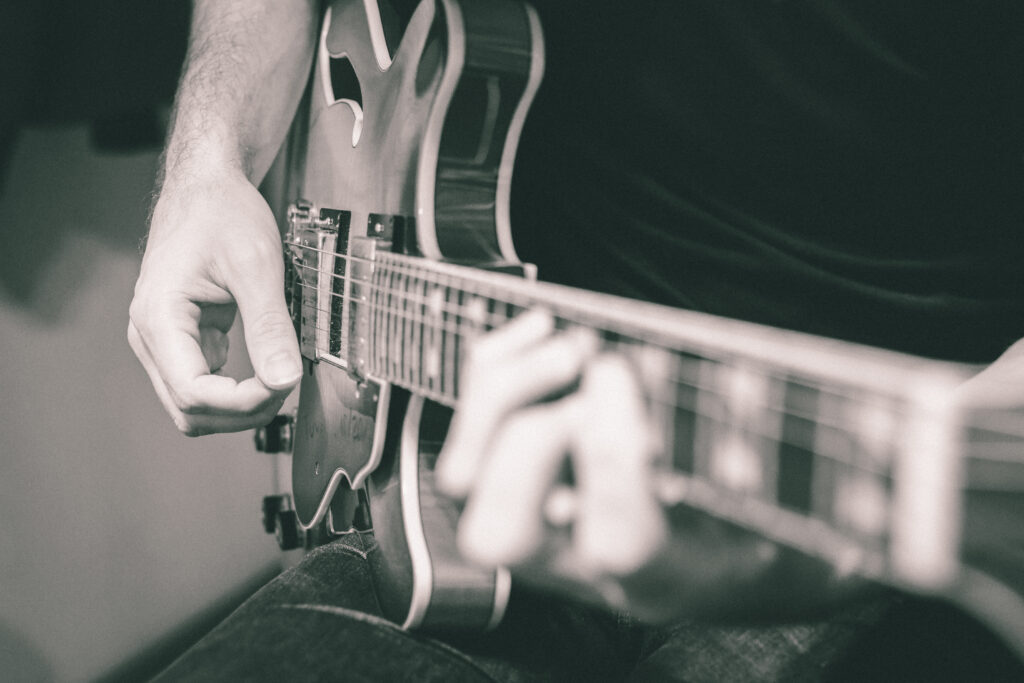
Andreas: I really like thick and warm guitar sounds—players like David Gilmour and Jimi Hendrix are my heroes. But of course, the tone has to fit the arrangement. So I always try to shape the sound to suit the song. That’s the main goal.
Personal & Creativity
Q: You studied guitar and also teach and write about the instrument. How has formal learning—and later teaching—changed your creativity?
Andreas: I love diving deeply into these topics. I’m always discovering new things that interest me and that I want to learn. Even when I’m teaching a student something, I want to know exactly what I’m talking about so I can explain it well—so you’re constantly working on yourself. Many students also inspire me to explore new ideas. For me, being open-minded definitely fuels creativity.
Q: On stage, you’re playing music that people instantly recognize; in ambient/downtempo, you’re shaping a mood that is more personal and abstract. What does “authenticity” mean to you across these two extremes?
Andreas: Yes, true—I play in very different genres. For many people, those seem to contradict each other. Not for me. I just love the variety, and in the end it’s all music. There are only two cases: either I like it or I don’t. The main goal is always to move people with music.
Q: When self-doubt or creative silence shows up: what helps you move through it? Do you reach for the guitar, the studio, a walk, a routine—what actually works?
Andreas: Listening to new music. Picking up a new instrument. Collaborating with other people. Or doing something completely unrelated to music for a few days. It always comes back.
Inspiration & Listening
Q: What inspires you most right now—other musicians, films, games, places, books, daily life? And how does that inspiration translate into sound?
Andreas: For me it’s almost always the same: listening to new music and really immersing myself in it—and making music with cool, creative people.
Q: If you could recommend one piece of music—any genre—that everyone should listen to at least once, what would it be (and why that one)?
Andreas: It changes all the time for me. But at the moment, I’m really into Ólafur Arnalds (an Icelandic composer somewhere between neoclassical and ambient). Give “Þú ert jörðin” a listen—what a beautiful little composition. Minimalistic, soulful, and deeply touching.
Creative Philosophy & Vision
Q: In ambient/downtempo, the line between “beautiful” and “boring” can be thin. How do you keep your music emotionally alive—without overfilling it?
Andreas: Finding good melodies. Finding nice and interesting sounds. Not overproducing, but still paying attention to cool little details. Avoiding too much copy & paste. Finding an original style that hasn’t been heard a thousand times before. Keeping the music human and natural.
Q: If there were no limits—no budget, deadlines, or technical restrictions—what would your dream project be right now?
Andreas: For example: locking myself away with Ólafur Arnalds somewhere in Iceland and composing an album together. Experiencing magnificent nature and getting inspired.
From Silence to Sound – Creative Identity
Q: Looking back, what were the biggest turning points that changed how you make music?
Andreas: Learning how to record myself—and learning how to produce.
Closing
Q: When someone listens to your ambient/downtempo music, what do you hope it gives them—calm, focus, comfort, energy, a sense of story, something else?
Andreas: It should always touch the listener in some way—so they stay tuned in and want to hear more.
Q: If you could give one piece of advice to someone at the beginning of their creative journey—especially someone navigating doubt or a “silent phase”—what would it be?
Andreas: If you enjoy it, just do it—do it for yourself. Finish your songs. It gets a little better each time. Don’t compare yourself to others. Everything else will gradually fall into place on its own.
Q: Finally: what’s next for you?
Andreas: I’m already working on new songs of my own, and new collaborations are planned again.