Introduction
Every producer wants a recognizable sound. But the search for a signature sound can easily become a trap.
You listen to your favorite artists, admire their identity, and wonder how they became so unmistakable. Their chords, textures, rhythms, mix decisions, use of silence, or emotional tone seem to belong only to them. Then you sit in front of your own project and ask the difficult question: What makes my music mine?
The answer is usually not found by copying a genre, buying another plugin, or forcing yourself into a concept. Your signature sound is not a costume. It is the result of repeated personal decisions.
It grows from the way you hear harmony, the sounds you are naturally drawn to, the emotions you return to, the mistakes you decide to keep, and the things you leave out when everyone else would add more.
In my own music, I have often noticed that the most personal moments are not necessarily the most complex ones. They are the moments where I stop trying to impress and start listening more honestly. Sometimes a simple chord, a fragile texture, or a moment of silence says more about an artist than a technically perfect arrangement.
In my book From Silence to Sound – Unlocking Creativity in Music Production, I explore this idea in depth: your artistic voice is not separate from your production process. It is revealed through it.
What Is a Signature Sound?
A signature sound is the set of qualities that makes your music recognizable even before someone sees your name.
It can be obvious, like a specific synth tone, vocal treatment, drum sound, guitar texture, or piano style. But often it is more subtle:
- the kind of emotional space your music creates
- the way your arrangements breathe
- the balance between complexity and simplicity
- the tempo range you naturally prefer
- the colors you choose when designing sounds
- the level of imperfection you allow
- the way you handle tension and release
- the atmosphere listeners associate with you
Your signature sound is not just sound design. It is musical behavior.
It is the way you make decisions.
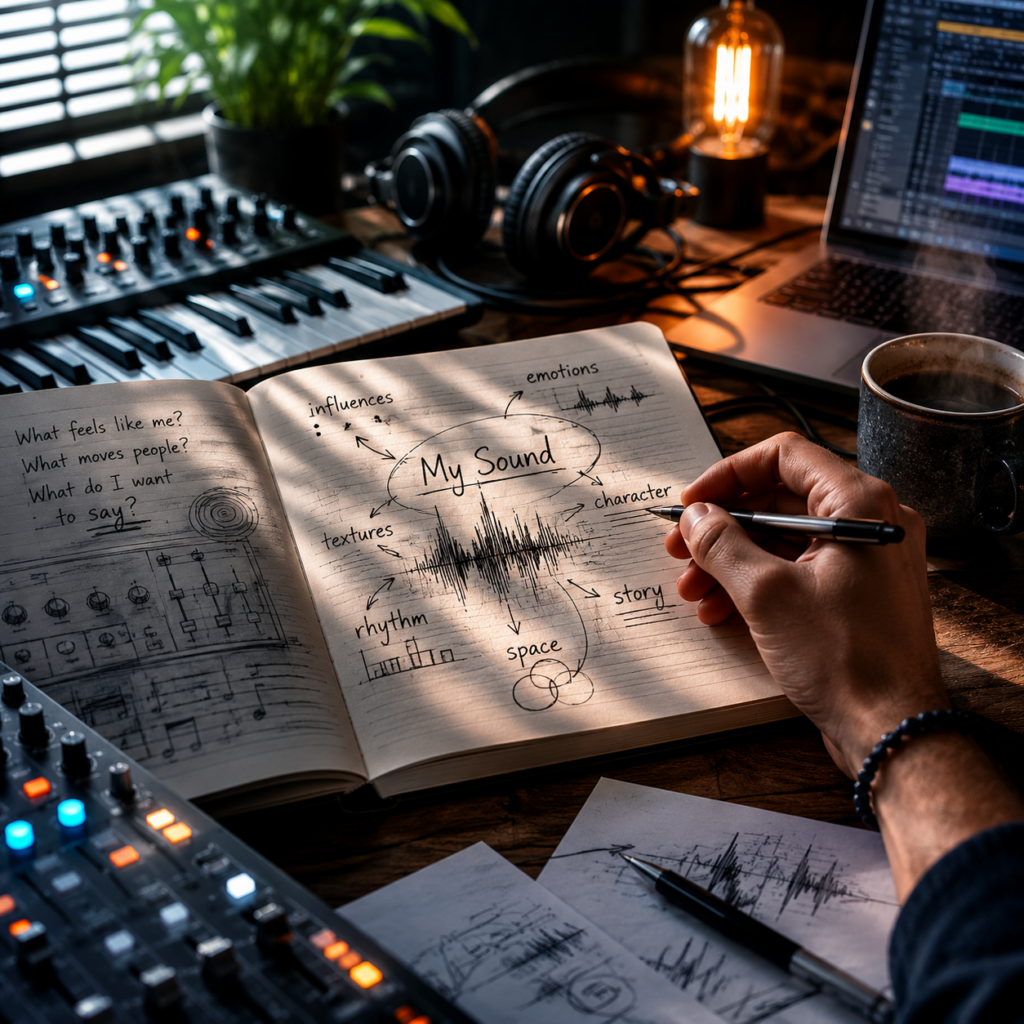
Stop Searching Outside Before Listening Inside
Many producers begin by asking: “What sound is working right now?”
That question can be useful from a marketing perspective, but creatively, it can lead you away from yourself. A more powerful question is:
What do I keep doing, even when I do not plan it?
Maybe you always gravitate toward minor chords. Maybe your melodies are slow and spacious. Maybe you prefer dusty drums, soft attacks, wide reverbs, or intimate piano tones. Maybe you avoid aggressive sounds. Maybe every track somehow ends up cinematic, nostalgic, reduced, or melancholic.
These recurring tendencies are not weaknesses. They are clues.
In the Polished Chrome interview, his identity emerges through atmospheric grooves, nostalgia, headphone detail, and emotional electronic textures. In the Mattiaca interview, the signature is built from felt piano, soundscapes, restraint, and a sense of place. In the MALIWA interview, the identity is connected to guitar-driven lo-fi, jazzy harmony, warmth, and consistency.
Different artists. Different tools. Different genres. But the pattern is the same: identity comes from repeated personal choices.
Your Sound Is Hidden in Your Limitations
Many producers believe they will find their voice once they have better equipment, more sample packs, more plugins, or a larger studio.
But limitations often reveal identity faster than abundance.
When you have fewer options, you are forced to make clearer decisions. You return to the sounds that matter. You discover what you can do well. You find workarounds. You develop habits. Those habits become recognizable.
A limitation could be technical: only using one synth for an EP.
It could be musical: writing with only three chords.
It could be emotional: making an album around one feeling.
It could be structural: finishing every idea within seven days.
It could be aesthetic: avoiding bright drums, avoiding obvious drops, or using silence as a core element.
A signature sound often begins when you stop trying to be unlimited.
Make a Sonic Fingerprint List
A practical way to discover your sound is to analyze your own finished tracks.
Choose five pieces of music you have made that still feel honest to you. They do not have to be your most successful tracks. They simply need to feel like you.
Now write down what they have in common.
Harmony
Do you use certain chord types again and again? Suspended chords? Minor sevenths? Open fifths? Modal progressions? Slow harmonic movement?
Melody
Are your melodies simple, spacious, repetitive, vocal-like, fragmented, or highly developed?
Rhythm
Do your tracks move through groove, pulse, texture, or atmosphere? Are the drums central or secondary?
Sound Design
Which textures appear repeatedly? Warm pads, granular sounds, field recordings, analog synths, felt piano, processed guitar, tape noise, deep bass, airy percussion?
Space
Is your music dry and close, wide and cinematic, intimate and small, or immersive and atmospheric?
Emotion
What feelings return? Hope, nostalgia, solitude, calm, longing, tension, wonder, melancholy, release?
Arrangement
Do you build slowly? Do you avoid big contrasts? Do you prefer minimal development? Do your tracks unfold like landscapes rather than songs?
After this exercise, you may notice that your sound is already there. It simply needs to be understood, refined, and trusted.
Inspiration Is Not Imitation
Every artist is shaped by influence. There is nothing wrong with studying the music you love. In fact, careful listening is essential.
The problem begins when influence turns into dependency.
A healthy relationship with influence sounds like this:
- “I love how this artist creates space. How can I create space in my own language?”
- “This track uses only a few elements. What can I learn about restraint?”
- “This mix feels warm and intimate. What production choices create that feeling?”
- “This melody is simple but emotional. How can I become more direct in my own writing?”
An unhealthy relationship with influence sounds like this:
- “How do I sound exactly like this artist?”
- “Which preset did they use?”
- “What template will make me sound professional?”
- “What genre label should I copy to get streams?”
Study references, but do not disappear into them. Your goal is not to become a better imitation. Your goal is to become more clearly yourself.
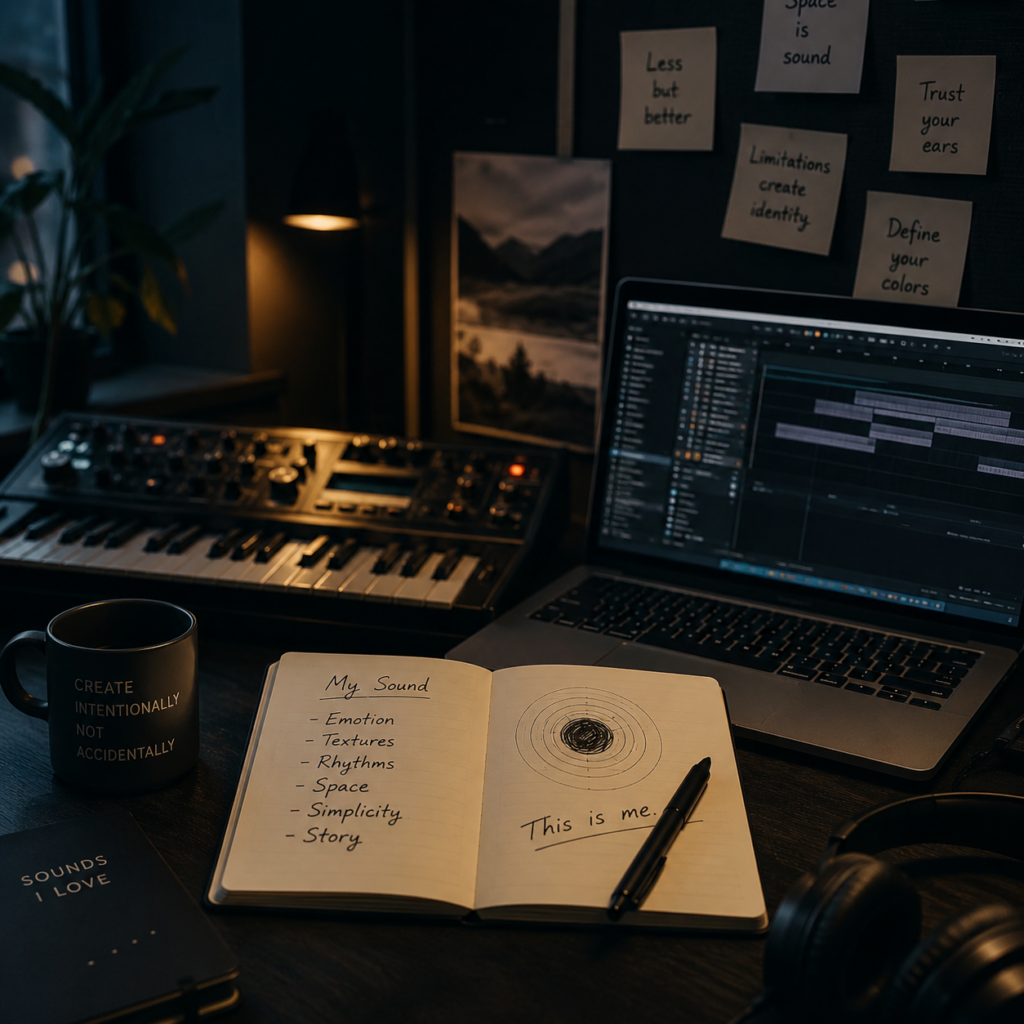
Signature Sound Is Also What You Refuse
Your identity is shaped not only by what you choose, but also by what you reject.
Maybe you refuse to make music louder than it needs to be.
Maybe you avoid overproduction.
Maybe you do not use obvious build-ups.
Maybe you leave space where others add percussion.
Maybe you keep fragile sounds instead of replacing them with polished ones.
Maybe you do not chase every current trend.
These refusals matter.
They create boundaries. Boundaries create taste. Taste creates identity.
The Role of Emotion
A signature sound is strongest when it is connected to emotion.
Listeners may not know which synth you used, which compressor shaped the mix, or which reverb created the space. But they will remember how the track made them feel.
That is why emotional consistency matters. It does not mean every track must sound the same. It means your music should return to a deeper emotional truth.
Ask yourself:
- What emotional world do I keep returning to?
- What do people feel when they listen to my music?
- Do I want my music to calm, energize, comfort, disturb, focus, open, or transport?
- What kind of silence exists before my music begins?
- What kind of feeling remains after it ends?
These questions are at the center of creative identity. They are also a major theme of From Silence to Sound, where I go deeper into how personal decisions shape timeless music.
A Practical Exercise: The Three-Track Identity Test
Create three short tracks using the same creative restrictions.
For example:
- one main instrument
- one drum or rhythm source
- one emotional keyword
- one tempo range
- one type of space
- one week to finish all three sketches
Do not try to make them perfect. Try to make them honest.
When the three tracks are finished, listen back and ask:
- What did I repeat naturally?
- What felt forced?
- Which choices felt most personal?
- Which sounds made me want to continue?
- Which limitations helped me sound more like myself?
This exercise is powerful because it removes the illusion that identity is abstract. You discover it through action.
Final Thoughts
Your signature sound is not a destination you reach once and keep forever. It is a relationship with your own creative instincts.
It grows every time you finish something, honestly. It becomes clearer every time you choose meaning over fashion, taste over excess, and emotional truth over imitation.
If you want to explore this journey more deeply, From Silence to Sound was written as a companion for producers who want to create with more identity, clarity, and confidence.
FAQ
How long does it take to find your signature sound?
Usually longer than you want, but less time than you fear. Your sound develops through finished work, not endless preparation. The more music you complete, the clearer your patterns become.
Do I need expensive gear to develop a unique sound?
No. Expensive gear can be inspiring, but identity comes from decisions, not price. A producer with strong taste and simple tools will often sound more recognizable than someone with unlimited options and no direction.
Can my signature sound change over time?
Yes. A signature sound is not a prison. It should evolve as your life, taste, skills, and emotional world change. The goal is not to repeat yourself forever, but to remain connected to your own creative truth.
Related Articles on From Silence to Sound
- What 10 Artist Interviews Taught Me About Creativity in Music Production
- Polished Chrome Interview
- Mattiaca Interview
- MALIWA Interview